The 2nd

Asia Design and Innovation Conference

November 20 - 21, 2025
Shanghai, China

Conference Theme

Designing for Smart and Sustainable World

Addressing both basic and fundamental design and innovation research and education issues and new breakthrough research and education topics including design for smart and sustainable human experiences.

View Full Conference Program

Access the complete schedule, session details, and abstract information

Open Conference Program →

Keynotes Speakers

Yong Zeng

Yong Zeng

Professor, Concordia Institute for Information Systems Engineering, Concordia University

Dr. Yong Zeng is a Full Professor with the Concordia Institute for Information Systems Engineering, Concordia University, Montreal, Canada. His research is focused on design theory and its applications to transdisciplinary design problems. Using the Environment-Based Design (EBD) methodology he has proposed, he and his colleagues have designed many algorithms. He pioneered EEG-based neurocognitive studies of human design, particularly creative design. He was Canada Research chair (Tier II) in Design Science (2004-2014) and NSERC chair in Aerospace Design Engineering (2015-2020). He is a member of the Board of Directors in the Society for Design and Process Science.
Change by Design – Is There a Universal Approach?
Everywhere we look, design is called upon to enable change—toward smarter systems, more sustainable practices, and better human experiences. Yet design research and practice remain fragmented across domains and methods. This keynote asks: Is there a universal approach to design? I propose that such an approach must operate at three interconnected levels. At the scientific level, we need principles and rigorous neurocognitive experiments that explain how design transforms environments and behaviors. At the methodological level, environment-based design (EBD) illustrates how these principles can structure processes. At the applied level, transdisciplinary projects show how designing the conditions for action can produce measurable, sustainable change.
Ji-Hyun Lee

Ji-Hyun Lee

Professor, Graduate School of Culture Technology, Korea Advanced Institute of Science and Technology

Ji-Hyun Lee is a Professor at the Graduate School of Culture Technology in KAIST. She received her Ph.D. in School of Architecture (Computational Design) at Carnegie Mellon University. Her research focus is on three interdisciplinary areas: (1) Calculation for UX + service design, (2) Physical/virtual proximity in city, and (3) Future education with AI. She is the Director of the Information-Based Design (IBD) Lab in KAIST and received Sasada prize from CAADRIA in 2019. She serves as Editor-in-chief of Korea Institute of Design Research Society (KIDRS).
Recent Trends in Computational Design
The recent trends in Computational Design can be broadly categorized into four areas: Generative Design with AI Integration, (Real-time) Simulation & Visualization, Interdisciplinary Applications (HCI, Bio-inspired Engineering), and Digital Fabrication & Material Efficiency. I will focus on introducing the field of Simulation and Visualization, and I have recently conducted a series of studies focusing on network analysis based on Graph Theory to examine user experiences within virtual spaces. Additionally, I will briefly discuss my emerging research on integrating Shape Grammar with the Case-Based Reasoning paradigm.
Philip Cash

Philip Cash

Professor, School of Design, Arts and Creative Industries, Northumbria University

Philip Cash is a Professor of Design at the School of Design, Arts and Creative Industries, Northumbria University. He received a PhD in engineering design from the University of Bath in 2012. His research focuses on design processes with a particular interest in the processes and methods of design for behavior change. He also works on research quality, methodology and theory in design. Over the last decade he has published multiple journal papers on design for behavior change based on close collaboration with industry as well as co-authors from across design, management, and behavioral science.
Behavioral Design: Opportunities for Cross-disciplinary Design for a More Sustainable World
The realization of sustainable behavior change through design is a rapidly growing area of research and practice. Key to this emerging practice is the drawing together of disciplinary insights from at least design, psychology, behavioral science, and persuasive technology. However, this rapid growth and diverse lineage presents significant challenges to systematizing practice as well as current design theory and methodology. At the root of these challenges is the tension between the multidisciplinary nature of these practices and the typically disciplinary perspectives taken to them in most processes and models.
Nan Cao

Nan Cao

Vice Dean, College of Design and Innovation, Tongji University; Professor, Shanghai Innovation Institute

Nan Cao is the Vice Dean of the Tongji College of Design and Innovation, and a professor at Shanghai Innovation Institute. He has been recognized as one of Forbes China's Top 20 Intelligent Industrial Designers, a Microsoft Most Valuable Professional, and recipient of the IBM Outstanding Technical Achievement Award. His research focuses on the intersection of artificial intelligence and design, particularly AI + information design, interaction design, and industrial design. He has published over 150 papers and received multiple Best Paper Awards.
From Intelligence Emergence to Creativity Emergence: Intelligent Design Study based on LLM
Artificial intelligence, driven by large-scale models, is transforming the landscape of design innovation. Yet, a critical gap remains between intelligence and creativity—the leap from algorithmic reasoning to genuine originality. This talk examines how design is evolving under the influence of large models, moving from intelligent assistance toward human–AI co-creation and ultimately autonomous creativity emergence. The talk concludes by outlining future trajectories of intelligent design.

Invited Talk

Mari Suoheimo

Mari Suoheimo

Associate Professor, Oslo School of Architecture and Design

Mari Suoheimo is an associate professor of service design at the Oslo School of Architecture and Design, Norway. Her main research focus is on how to approach wicked problems in service design. Suoheimo has publications at highly ranked journals and is also part of the editorial board of The Design Journal and Contexts Systemic Design Journal. She is also a senior member of the ServDes Conference Committee.
Systemic Service Design
This talk is an engaging presentation on the newly released book Systemic Service Design, which explores how systems theories can be integrated into service design to address today's complex challenges. The book bridges theory and practice across global case studies, tracing the evolution of service design from creating touchpoints to driving organizational transformation and enabling collaboration across complex systems. This talk and discussion will explore how service design can evolve to meet the complexity of our world.
Avril Accolla

Avril Accolla

Associate Professor, Tongji University

Avril Accolla is an Associate Professor and the Director of the Research Lab for Sustainable Business & Cultural Bridge at the College of Design and Innovation, Tongji University. She is a Board Member of Italian Chamber of Commerce in China, delegate to relationships with scientific-academic Institutions; she served as Vice President of Design for All (DfA) Europe and DfA Italy and received the Compasso d'Oro Honorable Mention, the DfA Quality Label, and various Invention Patents. Her book Design for All, on Social Innovation for Sustainable Development, also translated in Spanish, is recently published in Chinese.
Human Diversity in Design, a Driver for Sustainable Excellence
Several disciplines, like Ergonomics, Marketing, Anthropology, Sociology, Material Culture, address people's needs and desires, sometimes to an individual level of customisation, their social relations on macro and micro level, their sense-making loop with and by artifacts: why does Design Science need its own designerly understanding of Human Diversity (HD) both in research and in implementation? How do the epistemological constructivist stages of Design matter to answer HD? How does Design Science, in its ontology, understand HD differently than other sciences? What is the role of Design's approach to HD in striving for Sustainable Development? This speech aims to address these questions through practical examples, highlighting the Design tools, methodologies and approaches employed. A Design for All approach is proposed where multiple stakeholders are seen as Real Individuals within their roles in selected Value Chains, and are addressed by Aspirations, Necessities, Abilities in the specific Product Service System Design context, rendering apodictic clustering useless, the Limit Experiencer meets the challenges of percentile deviations, and designed integration minimises up to elimination of Functionally Accessible Social Discrimination.

Workshop

🎓

Post Conference Workshop

Saturday, November 22, 2025 | 9:30 – 12:00

Workshop Moderator: Professor Philip Cash, Northumbria University

Theorizing in Design Research: Discussions and Implications for Design Cognition and Beyond
Theory development is central to advancing knowledge in the field. Yet based on recent work on design theory and design cognition it is becoming increasingly clear that there are several significant challenges facing the design research community. In this workshop I will share recent work in this area and then facilitate a constructive discussion aimed at helping participants unpack these issues and identify ways forward with potential implications for their own work as well as the field at large. If you are interested in design theory or theory engaged research – such as design cognition – then this workshop will provide useful insights and provoke reflections that can improve tangibly your work.
Registration: To participate, please send email to adic@tongji.edu.cn with Subject: Workshop

Call for Papers

Paper Templates & Submission

Download the required templates for your submission and access the conference management system

Conference Management System

https://www.conftool.net/adic2025/

Smart Experience Design

  • Design for Smart Living
  • Design for Smart Learning
  • Design for Smart Health
  • Experience Design
  • Interaction Design

Sustainable Innovation

  • Sustainable Design
  • Design for Circular Economy
  • Product-Service Systems
  • Service Design
  • Health Systems Design

Digital Transformation

  • AI in Design
  • Data-Driven Design
  • Design Informatics
  • Digital Transformation
  • Digital Design & Pedagogy

Design Theory & Methods

  • Design Process and Theory
  • Design Methods and Tools
  • Design Thinking
  • Design for Innovation
  • Business Model Innovation

Human-Centered Design

  • Human Behavior in Design
  • Design Creativity
  • Design Cognition
  • Design for X

Design Education & Practice

  • Design Learning
  • Design Education
  • Design Practice
  • Design Entrepreneurship

Important Dates

October 1, 2025
Paper Submission Deadline
October 21, 2025
Acceptance Notification
November 1, 2025
Program Announcement
November 5, 2025
Final Paper Submission
November 20-21, 2025
Conference Days

Registration Information

Conference Registration

All participants are required to register with a conference fee paid.

Registration period: October 10 - November 10, 2025

Participant Type DS Member Non-Member
Regular 1420 RMB / 200 USD 1775 RMB / 250 USD
Student 710 RMB / 100 USD 852 RMB / 120 USD

Note:

The conference fee includes participation in all sessions, lunch, conference dinner, reception, coffee breaks, paper summary booklet, conference materials, etc., but does not include accommodation and transportation fees.

To join DS as a member, please visit www.designsociety.org

Payment Methods

Important Notes:

  1. Please note for remittance: ADIC 2025
  2. Please send a screenshot of the remittance to adic@tongji.edu.cn with subject: ADIC 2025 Payment
  3. Please complete payment before November 10, 2025
  4. If an invoice (发票) is needed, please send the required information to adic@tongji.edu.cn before November 10, 2025

开票所需信息:公司名称、纳税人识别号、注册地址、电话、开户银行、银行账号

Venue & Travel Information

Conference Venue

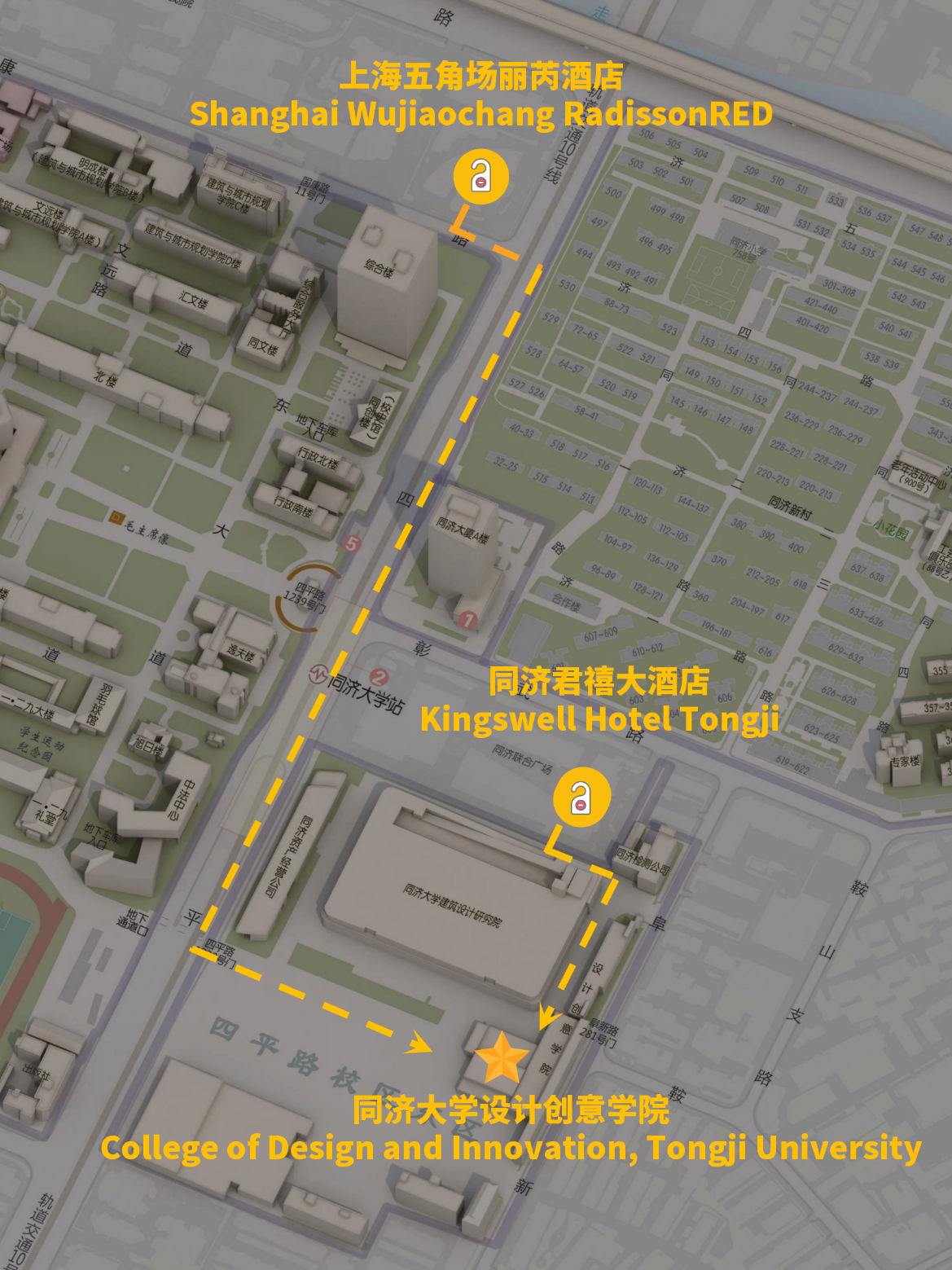
Tongji University, College of Design and Innovation

Address: 281 Fuxin Road, Yangpu District, Shanghai, P. R. China

Recommended Hotels

Kingswell Hotel Tongji

Address: No.50, Zhangwu Road, Yangpu District, Shanghai

Tel: +86 (21) 33626888

Email: junxi@kingswelltongji.com

Shanghai Wujiaochang Radisson RED

Address: NO.1251, Siping Road, Yangpu District, Shanghai

Tel: +86 (21) 65986888

Special Offer: We have negotiated discounted rates at this hotel. Please contact Ms. Zhang Wenwen with quotation "ADIC 2025-Tongji D&I"
Tel: +86 13918862720
Email: 652305828@qq.com

Note: The venue is easily accessible using Shanghai Metro (Tongji University Station, Line 10)

Location Map

Conference Venue Map

Transportation: Metro Line 10 - Tongji University Station

ADIC 2024 - First Conference Success

Asia Design and Innovation Conference 2024

The first ADIC was successfully held on December 5-6, 2024 in Shanghai, China, marking a significant milestone in fostering design and innovation collaboration across Asia. The conference featured 53 full papers, 9 presentation-only papers, 3 keynote speeches, and 3 invited theme speeches, with participation from 12 countries including China, Japan, Korea, Taiwan, Singapore, Hong Kong, Vietnam, Pakistan, Finland, UK, Italy, and Germany.
90+ submissions received
53 full papers
9 presentation-only papers
12 countries represented
3 keynote speeches
3 invited theme speeches

Conference Organization

Conference Chair

Yong Se Kim (Tongji University)

Conference Co-Chairs

Yutaka Nomaguchi (Osaka University)

Cees de Bont (National University of Singapore)

Jianxi Luo (City University of Hong Kong)

Organizing Committee Chair

Xiaofang Yuan (Tongji University)

Organizing Committee Members

Avril Accolla (Tongji University)
Eun Ji Co (Tongji University)
Linna Hu (Tongji University)
Meng Wang (Tongji University)
Qi Wang (Tongji University)
Le Yi (Tongji University)
Huasen Zhao (Tongji University)
Zhinan Zhang (Shanghai Jiaotong University)
Rudy Wimmer (New York University Shanghai)

Program Committee Members

Marco Bertoni (Blekinge Inst. of Technology)
Kom Campiranon (Thammasat University)
Juyoung Chang (Dongseo University)
Chun-Hsien Chen (Nanyang Tech. Univ.)
Hong Chen (Tongji University)
Takanori Chihara (Kanazawa University)
Christina Choi (Royal College of Art)
Daniel Chong (Sunway University)
Ethan Chong (Singapore Inst. Tech.)
Chih-Hsing Chu (National Tsing-Hua Univ.)
Zhu Gao (Shanghai Univ. of Engr. Science)
Georgi Georgiev (University of Oulu)
Ha Le (Foreign Trade University)
Christopher Han (Univ. Economics HCMC)
Ji Han (University of Exeter)
Spring Han (Kyoto University)
Ting Han (Shanghai Jiaotong University)
Yasuyuki Hayama (Kyushu University)
Yu-Hsiu Hung (National Cheng Kung Univ.)
Masato Inoue (Meiji University)
Tie Ji (Hunan University)
Takeo Kato (Keio University)
Chang H. Kim (Xian Jiaotong–Liverpool U)
Yusuke Kishita (University of Tokyo)
Tsuyoshi Koga (Yamaguchi University)
Edwin Koh (Singapore U. Tech & Design)
Ji-Hyun Lee (Korea Adv. Inst. Science & Tech.)
Ji Hwan Lee (Pukyong National University)
Jung-Ju Lee (National Univ. of Singapore)
Sheng-Hung Lee (MIT)
Jun Li (Donghua University)
Zhijun Li (Tongji University)
Wei Liu (King's College London)
Ding Bang Luh (Guangdong Univ. of Tech.)
Shijian Luo (Zhejiang University)
Seung Ki Moon (Nanyang Tech. University)
Yukie Nagai (University of Tokyo)
Giang Nguyen (RMIT Vietnam)
Thai Nguyen (Van Lang University)
Dave Rosen (Agency Sci, Tech. Research)
Melanie Sarantou (Kyushu University)
Yoshihiro Sejima (Kansai University)
James Self (Ulsan Nat'l. Inst. Science & Tech.)
Wenyan Song (Beihang University)
Lingyun Sun (Zhejiang University)
Hsien-Hui Tang (Taiwan U. Sci. & Tech.)
Kevin Tseng (National Taipei Univ. of Tech.)
Xiaochao Xi (Beijing U of Post & Telecom)
Hideyoshi Yanagisawa (University of Tokyo)
Jun Wang (East China Univ. of Sci. & Tech.)
Zuoxu Wang (Beihang University)
Lijun Zhang (Tongji. University)
Linghao Zhang (Nanjing University of the Arts)
Chao Zhao (Tsinghua University)
Pai Zheng (Hong Kong Polytechnic University)


Contact Information

Conference Chair: Prof. Yong Se Kim (Tongji University)

Email: adic@tongji.edu.cn

Venue: College of Design and Innovation, Tongji University, Shanghai